
Rwanda: The Investment Frontier Hiding in Plain Sight
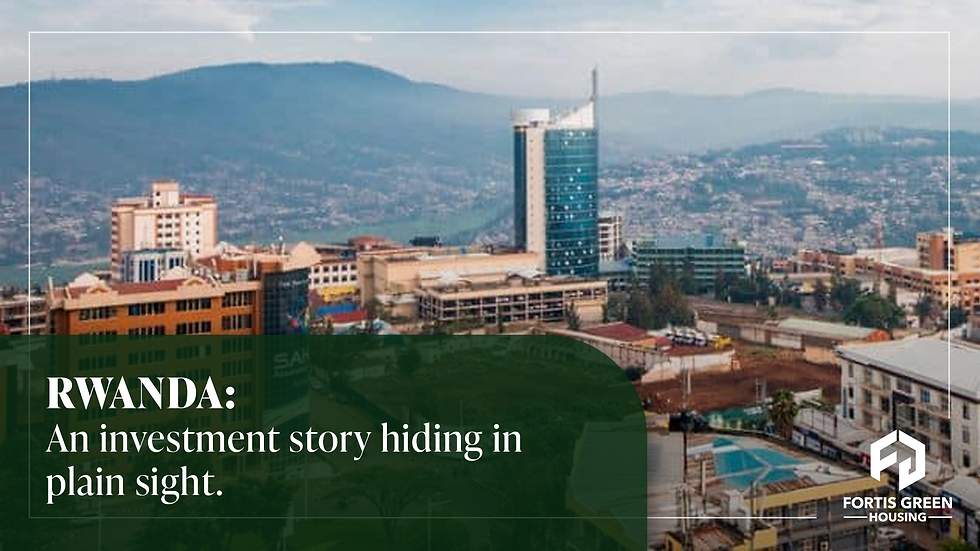
Every so often, global investors collectively “discover” a country. It happened with Singapore in the 1980s, with Dubai in the early 2000s, and with Vietnam a decade later. Yet one of the most quietly compelling investment frontiers today is not emerging from a port, a megacity, or a coastline, but from a small, landlocked nation that has figured out how to turn constraints into catalysts.
Rwanda is not just rising. It is designing its rise.
And for investors (particularly those who appreciate long-term strategy, policy stability, and disciplined national execution) Rwanda may be offering one of the most quietly intelligent investment environments on the continent.
This is not the typical “Africa rising” narrative, nor a glossy brochure about mountain gorillas. The real story is far more interesting, and far more investable.
A Country That Plans in Decades, Not Election Cycles
Many markets operate in short bursts of policy enthusiasm: grand announcements followed by equally grand slowdowns. Rwanda, by contrast, is playing a long game. Its economic roadmap (from Vision 2020 to Vision 2050) is not a political promise; it is a national operating manual. It transcends governments, budgets, and personalities. It is a continuity plan.
This matters for investors more than any tax incentive ever could.
Predictability is often the rarest asset in emerging markets. Rwanda has made it its core export.
Infrastructure development, tech integration, social services, environmental standards, and urban planning all follow the same principle: progress must be structured, measurable, and sustained. It’s an approach more reminiscent of Scandinavian governance than a small, fast-growing African nation - and that contrast is precisely why Rwanda is so intriguing.
The Real Competitive Advantage: National Efficiency
If you speak to seasoned investors who have been involved in Rwanda for years, they all mention a pattern: things work.
Not “work” in the sense of being perfect - no system is - but “work” in the sense that processes are clear, institutions are responsive, and decisions can be executed without a labyrinth of delays. Rwanda’s regulatory environment is not simply friendly; it is engineered to reduce friction.
This “national efficiency” is not a marketing tagline. It shows up in areas such as:
Company registration in less than 6 hours
Construction permits that no longer take months
A digital land registry that works predictably
Civil service reforms that reward performance
These may sound like administrative details. They are not. They form the invisible scaffolding of an investment-ready economy.
If capital is oxygen, efficiency is the bloodstream.
A Country Designing the Future Around Health, Tech, and Sustainability
While many nations talk about the future, Rwanda is building around it with a kind of intentionality that’s both refreshing and rare.
Kigali Innovation City is quietly positioning itself as Africa’s future knowledge hub.
The new Kigali Medical City will anchor a regional health-science ecosystem.
The countrywide drone logistics network, used for medical deliveries long before the world considered them mainstream, is a case study in applied innovation.
Green building standards and aggressive sustainability policies are shaping what the next generation of African urban development looks like.
It is not that Rwanda is trying to copy the usual models. It’s designing its own: small, efficient, technology-enabled, health-oriented, and deliberately green.
Investors who think in systems rather than silos instantly recognize the possibilities that emerge from such alignment.
Real Estate: The Silent Giant of Long-Term Returns
Rwanda’s real estate market has long been misunderstood by outside observers. Many assume it follows the typical “African capital city boom cycle” - a flood of development, followed by oversupply and price corrections. Rwanda is different.
Two forces are reshaping the landscape:
A. Kigali’s population is growing faster than housing supply.
Urban migration, a young demographic, rising income levels, and an influx of regional professionals and international organizations mean demand is rising steadily.
B. Development is regulated for quality rather than quantity.
This avoids the pattern seen in many capitals where speculative construction races ahead of planning.
Add to that the country’s emerging health-city corridor in Masaka, new industrial zones, and tech hubs, and it becomes clear that Kigali is not expanding randomly - it is expanding intelligently.
For investors, this translates into something remarkably rare: measured growth with structural demand. Projects that align with urban growth strategies, such as sustainable housing estates, mixed-use nodes, and health-adjacent residential clusters, sit in a sweet spot between national policy and market need.
A Nation Where Trust Itself Is an Investment Asset
There are markets where investors chase incentives. There are markets where investors chase returns. And then there are markets where investors chase trust.
Rwanda has spent decades establishing trust in public institutions, the rule of law, and community-driven stability. These are not intangible cultural traits; they are economic multipliers. Trust lowers transaction costs, increases compliance, strengthens credit systems, and attracts higher-quality capital.
It also shapes something subtle but powerful: investor psychology.
Investors do not just ask, “What are the returns?” They ask, “Will this market still be stable, fair, and efficient in five years?”
In Rwanda, the answer is unusually clear.
The Diaspora Advantage: Investing With Insight, Not Distance
One of the fastest-growing investor groups in Rwanda is the diaspora - not because of nostalgia, but because they understand the speed and seriousness of the country’s development better than outsiders.
But something even more interesting is happening: Rwanda is increasingly attracting non-Rwandan diaspora investors from across Africa and the world; people who want exposure to a well-governed, future-focused market even if they have no ancestral ties.
This “global diaspora mindset” is opening new channels of investment: fractional ownership, remote property acquisition, overseas construction financing, and cross-border partnerships built on long-term alignment rather than short-term speculation.
Rwanda benefits from this capital. Investors benefit from the country’s reliability. It is, in many ways, the new model of emerging-market investment: borderless, data-driven, and trust-centred.
The Real Opportunity: Early Movers With Long Horizons
Every investment wave has early movers - those who recognize the fundamentals before the market becomes both crowded and expensive. Rwanda is in that window right now.
The story of Rwanda is not about rapid, chaotic expansion. It is about deliberate, sustained, disciplined growth, a kind that rewards patient, sophisticated capital. Investors seeking stability and long-term value creation rather than speculative spikes will find in Rwanda a market that reflects their mindset.
To invest in Rwanda today is not to arrive late. It is to arrive exactly when the foundations are strongest and the trajectory is clearest.
The world is full of markets that promise opportunity. Rwanda is building it.
And that simple difference - between promise and design - is why this small nation is becoming one of the most compelling investment stories of our time.



Comments